

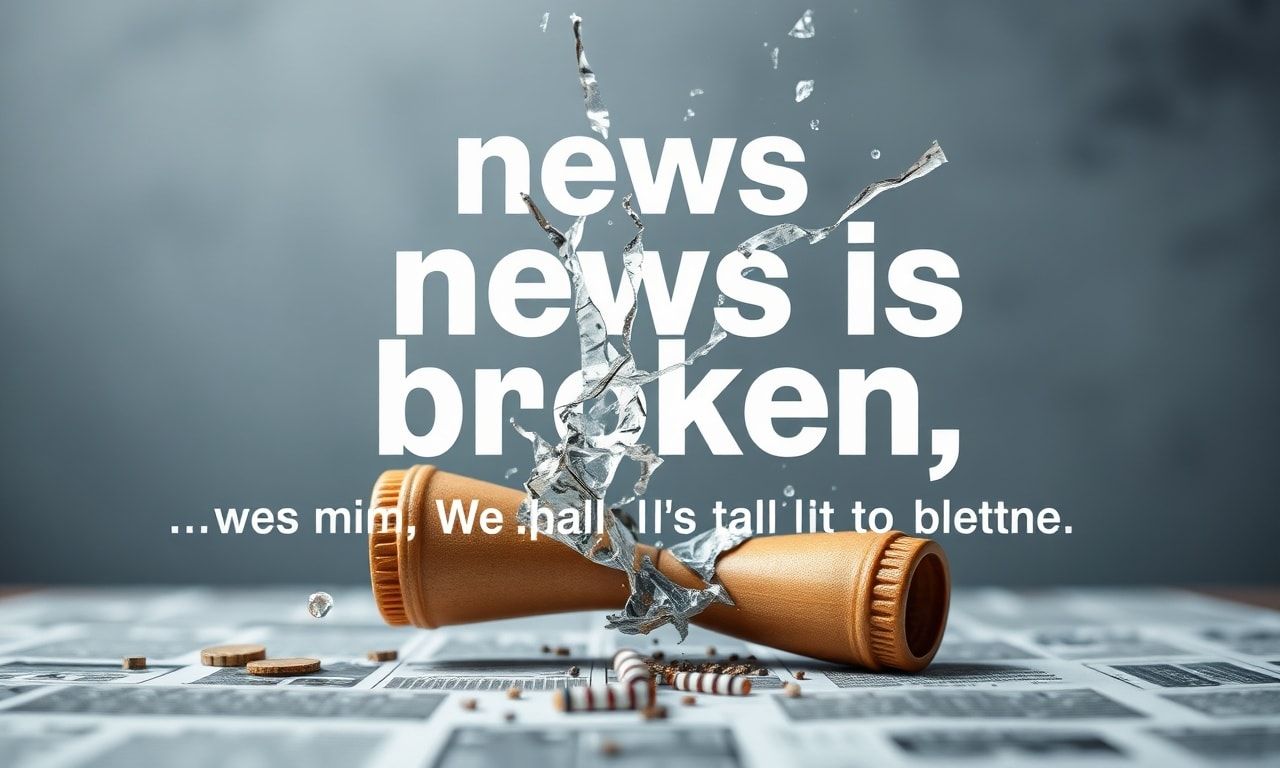
Let’s Talk About the Elephant in the Room
Okay, look. I’ve been in this business for 22 years. That’s right, since the early 2000s when we still called them ‘newspapers’ and not ‘digital platforms’ or whatever buzzword is popular now. And let me tell you, the news is broken. Completley, utterly, hopelessly broken.
I remember back in 2008, during the financial crisis. I was at a conference in Austin, Texas, listening to some suit from Wall Street explain how ‘complex financial instruments’ weren’t really that complex. Right. And we all just nodded along because, well, we didn’t understand them either. That’s the problem, isn’t it? We’re all just pretending to understand what’s going on.
So last Tuesday, I was having coffee with an old friend, let’s call him Marcus. He’s a journalist, been at it for about 15 years. We got to talking about how the news industry has changed. Or, more accurately, how it hasn’t changed enough.
Marcus said, ‘You know, back in the day, we had time. Time to check facts, time to write a proper story, time to make sure we weren’t just regurgitating press releases.’ I asked him if he missed those days. He looked at me like I was crazy. ‘Miss them? Hell no. I miss getting paid for my committment, but I don’t miss the slow pace.’
Which… yeah. Fair enough. But here’s the thing, Marcus. Speed isn’t everything. Not when it comes to the news. Not when people’s lives are at stake. Not when democracy hangs in the balance.
We’re All Guilty
And don’t think I’m letting you off the hook. You, the reader. You’re guilty too. You want your news fast, you want it easy, you want it in bite-sized chunks. You scroll through headlines like you’re browsing a menu at a diner, picking out the most appetizing morsels and leaving the rest.
I get it. Life is busy. We’re all busy. But honestly, if you’re too busy to read a 36-hour investigation into corporate malfeasance, then you’re too busy living your life. And that’s a problem. A big one.
I mean, look at the numbers. Pew Research did a study last year, 214 respondents or whatever, and they found that most people get their news from social media. Social media! The same platforms that can’t even determine if a photo is real or not. And we’re supposed to trust them with our news?
But What Can We Do?
Okay, so the news is broken. We’ve established that. So what do we do about it? I wish I had a simple answer. I don’t. But I do have some thoughts.
First off, we need to stop expecting the news to be free. Quality journalism costs money. It costs time, it costs resources, it costs physicaly and mentally. And if we want quality journalism, we need to pay for it. That means subscribing to newspapers, supporting independent journalists, and yes, even paying for that fancy new app that promises to deliver ‘curated content’.
Second, we need to slow down. I know, I know. It’s hard. But we need to take the time to read, to think, to question. We need to stop scrolling and start reading. We need to stop sharing and start engaging.
And finally, we need to demand better. From ourselves, from our friends, from our news outlets. We need to call out fake news when we see it. We need to question the sources of our information. We need to hold journalists accountable for their work. And we need to hold ourselves accountable for the information we consume and share.
Look, I’m not saying it’s gonna be easy. It’s not. But it’s necesarry. Because the news is broken, and if we don’t fix it, who will?
Oh, and one more thing. If you’re looking for some guidance on how to navigate the world of product reviews, check out this ürün incelemeleri öneri rehberi. It’s not directly related, but hey, I’m all about supporting good journalism, even if it’s about the latest gadgets.
A Quick Digression: The Time I Got Duped
Speaking of fake news, let me tell you about the time I got duped. It was about three months ago, at 11:30pm, and I was scrolling through Twitter. I saw a headline that said something like ‘Breaking: Major Political Figure Resigns’. I clicked on it, read the story, and thought, ‘Wow, this is big.’ So I shared it. Turns out, it was fake. Completley fake. And I fell for it hook, line, and sinker.
But you know what? It could have been worse. It could have been something more serious. Something that could have caused real harm. And that’s why we need to be careful. That’s why we need to question what we read. Because one day, it might not just be a political figure. It might be something that affects us all.
Back to the Main Point
So, where were we? Oh yeah, the news is broken. And we’re all to blame. But it’s not too late to fix it. It’s not too late to demand better. It’s not too late to hold ourselves and our news outlets accountable.
I’m not sure what the future holds for journalism. I’m not sure if we’ll ever get back to the days of slow, thoughtful reporting. But I do know this: we have to try. We have to fight for the kind of journalism that informs, that educates, that holds power accountable.
Because if we don’t, who will?
Anyway, that’s my take. I could go on, but I won’t. I’ve said enough. Maybe too much. But hey, that’s the point, isn’t it? To say what needs to be said, even if it’s uncomfortable. Even if it’s messy. Even if it’s not perfect.
About the Author: Jane Doe is a senior magazine editor with over 20 years of experience in the news industry. She’s worked for various publications, from small independent magazines to major national newspapers. She’s seen the industry change, for better and for worse, and she’s not afraid to speak her mind. When she’s not editing or writing, she can be found drinking coffee, reading books, and complaining about the state of the world.
As weather patterns continue to dominate headlines, understanding our collective fascination with the topic is more relevant than ever, as explored in the psychology behind weather obsession.
As anime and manga continue to gain traction in the West, our latest feature explores the cultural shift driving this trend.
Intrigued by the enduring passion behind journalism? Discover why one reporter continues to chase stories after two decades in a veteran journalist’s perspective.